Showing posts with label plagiarism. Show all posts

Thursday, March 7, 2013

"[…] mea culpa, mea culpa, mea maxima culpa. […]" — from the The Confiteor of the Catholic Mass (Wikipedia)


"[…] The gist of the thing is this: novelist Ian McEwan had just been accused [2008] of plagiarising from a historical memoir in his novel Atonement […]
     Authors of the caliber of Margaret Atwood, Kazuo Ishiguro, John Updike, Zadie Smith, Martin Amis and even Thomas Pynchon (who is notorious for shunning publicity) all wrote letters published in that week’s Daily Telegraph, basically standing up and saying 'I am Spartacus' – saying that if [Ian] McEwen was to be so casually accused of this heinous crime then they themselves were intimately acquainted with the crime in question. If anyone was to be waving a tar brush, it seemed, the overwhelming response from the writers was 'tar one, tar all.' The authors all admitted with gay abandon that they themselves had cheerfully plundered other work – be it historical writing, autobiography, primary-source documents, even other novels – in the writing of their own books, and said that such research was the lifeblood of any novel that depended on period detail. […]
     Literary editor of the august Times of London, Erica Wagner, weighed in too: 'We have come to a pretty pass where an author like Ian McEwen has to write on the front page of The Guardian explaining what research is. The myth of originality? There’s no such thing.'
     Research is essential, and we all do it, from all sorts of sources. Some of the authors who wrote their letters in support of Ian McEwen revealed their own sources – Colm Toibin admitted to using actual phrases and sentences from the work of Henry James in The Master, his (fictional) re-imagining of a period in the life of said Henry James; Rose Tremain acknowledged that her book Music and Silence depended, as she put it, 'to a shocking extent' on a small illustrated book by the name of Christian IV by one Birger Mikkelson; […]"
— Alma Alexander, Science Fiction & Fantasy Novelist
Read more...

Monday, January 14, 2013

Oh Deer...


Photo: The old stocks at Chapeltown, Lancashire (Wikipedia)

The poet Christian Ward has said that he had 'no intention of deliberately plagiarising' [sic] the work of another writer after it was discovered that his prize-winning entry to a poetry competition was lifted 'almost word-for-word' from a poem by Helen Mort.
     Ward's poem The Deer at Exmoor won the Exmoor Society's Hope Bourne poetry prize, but organisers [sic] later discovered that it was virtually identical to an earlier work by Mort, Deer. The similarities were revealed by the Western Morning News last week, with Ward said by the paper to have replaced "\'only a handful of words,' switching 'father' for 'mother' in the first line, the 'river Exe' for 'Ullapool' and transforming Mort's description of 'the kingfisher / that darned the river south of Rannoch Moor' to a peregrine falcon on Bossington Beach.
     On learning of the similarities, Mort – whose collection Division Street will be published later this year by Chatto & Windus – wrote on Twitter: 'Thanks for the backhanded compliment, Mr Ward, but I think you'll find thieving poetry is bad karma. At the very least.'"
— Alison Flood, The Guardian
Read more…

You can find both poems in the "Comments" section of this article:

"[...] One of the West Country's best known poets, James Crowden, said: 'What Christian Ward has done is outrageous. Maybe Christian Ward should be put in the stocks in Dulverton and pilloried, and a large supply of rotten eggs and tomatoes gathered together. In fact, because the poem is about deer on Exmoor, he really should be tried and punished as if he was a deer poacher which, in ancient times, carried a very severe penalty indeed.'"
— This Is Cornwall
Read more...

Find out more about Helen Mort and her poetry here...

Wednesday, November 16, 2011

Pilfered Not Stirred


In 2007, [Quentin] Rowan self-published a collection of short stories. Using this presumably as his calling card, he signed a book deal with Little, Brown for a series of spy novels starring a James Bond-like hero, Jonathan Chase. He used the pseudonym QR Markham.
     In retrospect, that was a warning - the name had been copied from the pseudonym used by Kingsley Amis for his own James Bond novel.
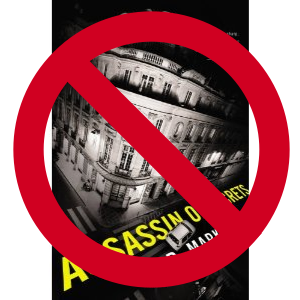
     The first book in the series, The Assassin of Secrets (sic), appeared at the beginning of November this year. It had a print run of 6,500, plus a deal to publish an edition in the UK. It was launched at a spy-themed party at [Brooklyn bookstore] Spoonbill & Sugartown. The book received a starred review from Kirkus (a 'dazzling, deftly controlled debut'), while Publishers Weekly said that while it 'strays far enough into James Bond territory to border on parody," the book was praised for its 'fine writing. [...] The obvious Ian Fleming influence just adds to the appeal,' it concluded.
     A week later, The Assassin of Secrets (sic) was dramatically pulled from bookstores after a James Bond forum spotted that passages in the book were copied word-for-word from prominent spy novels. The forum discussion was seen by the author Jeremy Duns, who was quoted praising the work on the back of the book. He immediately contacted the book's publishers.
     The book's withdrawal led to a brief spike in sales, and an in-depth confirmation of the charges by Edward Champion on the website Reluctant Habits, who found copied passages in the text from several spy novels including The Tears of Autumn [by Charles McCarry], and James Bond novels License Renewed and For Special Services.
     Champion also discovered that Rowan's stories for BOMB, The Paris Review, and a piece he wrote for us all contained heavily plagiarized material.

[In an interview with Jeremy Duns, Quentin Rowan says:]
"[...] things really got out of hand for me. I just didn't feel capable of writing the kinds of scenes and situations that were asked of me in the time allotted and rather than saying I couldn't do it, or wasn't capable, I started stealing again. I didn't want to be seen as anything other than a writing machine, I guess." [...]
     I rarely slept and mostly felt like an actor on a stage in my day to day life. Signing books made me feel deathly ashamed, around so many good people, but I'd already thrown the dice so long ago by that point I felt there was nothing I could do but play the out the awful pantomime... I can only compare it to other kinds of obsession or addictive behavior like gambling or smoking: in that there was no need to do it initially, but once I'd started I couldn't stop and my mind kept finding ways to rationalize the behavior. Even though, somewhere deep in the chasms of my thick brain, I knew it would destroy me."
— Andrew Losowsky, Huffington Post
Read more...

"[Quentin Rowan as Q.R.] Markham, Page 13 [of Assassin of Secrets] : 'The boxy, sprawling Munitions Building which sat near the Washington Monument and quietly served as I-Division’s base of operations was a study in monotony. Endless corridors connecting to endless corridors. Walls a shade of green common to bad cheese and fruit. Forests of oak desks separated down the middle by rows of tall columns, like concrete redwoods, each with a number designating a particular work space.'

Taken from [James] Bamford, Page 1 [of Body of Secrets: Anatomy of the Ultra-Secret National Security Agency] : 'In June 1930, the boxy, sprawling Munitions Building, near the Washington Monument, was a study in monotony. Endless corridors connecting to endless corridors. Walls a shade of green common to bad cheese and fruit. Forests of oak desks separated down the middle by rows of tall columns, like concrete redwoods, each with a number designating a particular work space.' ”
— Edward Champion, Reluctant Habits
Read more...

Sunday, November 6, 2011

Property Rights

Photo: Michael Hale


"Three Canadian writers filed suit last week against Penguin Canada’s parent company, Pearson Canada, alleging that its newly published English-language edition of Gold Mountain Blues infringes their copyrights. Wayson Choy, Sky Lee and Paul Yee are suing for $6-million, saying [Ling] Zhang’s book contains numerous elements copied from their work, including characters, plots and descriptions. Their statement of claim, which contains allegations not proven in court, gives several examples of similarities, including the story of a disfigured railway worker who saves his foreman from death, which appears in Choy’s 1995 novel The Jade Peony; the story of a Chinese man rescued by a girl of Chinese-native heritage, which appears in Lee’s 1990 novel Disappearing Moon Cafe; and the story of a Chinese boy rescued from bullies by his white employer, which appears in Yee’s 2004 young-adult novel The Bone Collector’s Son. [...]
     'We want to see the evidence and we will apologize if we are wrong,' Choy says. 'We don’t like this ... I react with anger, but some of us have reacted with tears.' " — Kate Taylor, The Globe and Mail
Read more...