 |
| From: Serendipitous Readings |
Monday, August 12, 2013

The Future... for now

"The modern world 'Utopia' came to life during early years of 16th century, in the work of the famous English philosopher Thomas Moore. His description of utopian society gave birth to enormous wave of utopian thought that influenced the life and works of many future philosophers and novelist, and helped in creation of several important political movements (most notably socialism).
Utopias that were envisioned by the minds of those authors can most easily be divided in several distinct categories, all based on the means of their creation – Ecology utopia, Economic utopia, Political utopia, Religious utopia, Feminists utopia and Science and technological utopia. 19th century gave the birth of the largest wave of utopian thought the world has ever seen. Numerous novelist and philosophers focused their careers on the exploration of those themes, and result of their work influenced the audiences across the entire world. Most notable utopian novel from that period was without a doubt Looking Backward by Edward Bellamy.

— Utopia and Dystopia
Read more...
According to Erich Fromm, Looking Backward is 'one of the most remarkable books ever published in America.' It was the third-largest bestseller of its time, after Uncle Tom's Cabin and Ben-Hur: A Tale of the Christ.
It influenced a large number of intellectuals, and appears by title in many of the major Marxist writings of the day. 'It is one of the few books ever published that created almost immediately on its appearance a political mass movement.' In the United States alone, over 162 'Bellamy Clubs' sprang up to discuss and propagate the book's ideas.
Owing to its commitment to the nationalization of private property, this political movement came to be known as Nationalism, not to be confused with the political concept of nationalism. The novel also inspired several utopian communities."
— Wikipedia
Read more…
8th Grade Grammar (1912)
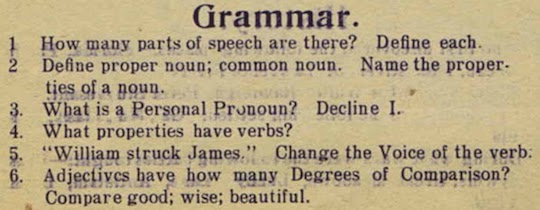
— Bullitt County History
Read more…
Tuesday, August 6, 2013
"... lit on fire with excitement"
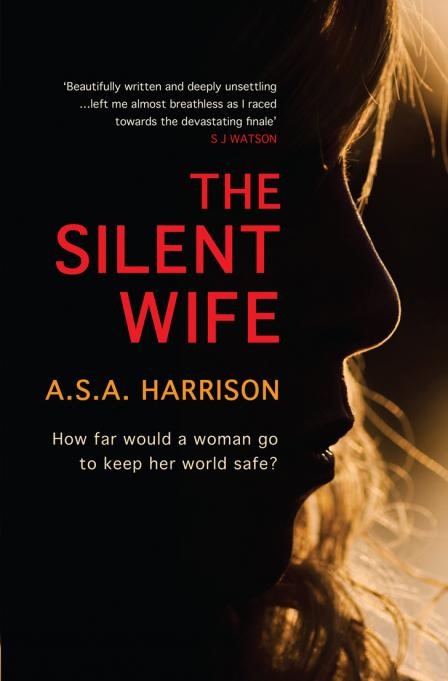
"… But The Silent Wife [by A. S. A. Harrison] has a striking story behind its publication that makes it an unlikely best seller: In a season that has been dominated by brand-name authors—Khaled Hosseini, Stephen King and J. K. Rowling—Ms. Harrison was a Toronto writer and an unknown, who had never published a novel before. Her book was released as a paperback original, not a hardcover, which is the preferred, more expensive format chosen when a publisher wants a book to make a big splash.
Samantha Haywood, Ms. Harrison’s literary agent in Canada, said that Ms. Harrison spent much of her career working as an editor and writing nonfiction under the name Susan Harrison.
Until The Silent Wife, Ms. Harrison’s attempts at fiction had sputtered out. She wrote two novels that Ms. Haywood described as 'cozy mysteries,' but they never sold to a publisher.
Then Ms. Harrison had the idea for The Silent Wife, with its concept of his-and-hers narratives. 'She was lit on fire with excitement,' Ms. Haywood said. “It was quite fully realized as an idea.'"
— Julie Bosman, The New York Times
Reads more…
Buy this book here...
Wilkie Collins: Gumshoe Groundbreaker
 |
| First Edition, 1871 (from: Wilkie Collins-Info.com) |
"...But I was surprised and delighted to discover a whole new set of pleasures in The Moonstone. As a writer, I was struck by how masterfully Collins pulls together the different strands of a complicated plot. T.S. Eliot called The Moonstone 'the first, the longest, and the best of the modern English detective novel.' I could see why. Reading the book was a little like seeing the Wright brothers maneuvering their first aircraft, except there was no awkward bucking, no crashes.
Many conventions of the detective novel that we take for granted — a mysterious crime that is systematically unraveled through a process of inquiry, a detective with unusual powers of analysis, the surprise when the criminal turns out to be someone unexpected — are being used by Collins for the first time."
— Chitra Banerjee Divakaruni, NPR Books
Read more…
"Dog-eared, spines broken..."

"This fantasy novel [A Spell for Chameleon] by Piers Anthony looked like a book for grown-ups: It was a mass-market paperback. Even if you don’t know the terminology, you know what a mass-market paperback is. It’s a pocket book, a pulp novel, a spinner-rack book. It’s the cheapest, smallest paperback format—the book designed for impulse purchase in the airport or drugstore. As a child, I read plenty of larger-format, or trade paperbacks—most of the middle-grade or young-adult novels I bought from Waldenbooks with my allowance money were printed at that size. And everything I took out from the library was a hardcover.
But when I saw adults reading books—at Bradford Beach on Lake Michigan, on the No. 15 bus we rode to my dad’s office downtown—they were mass-markets. Dog-eared, spines broken, they fit in a purse or a pocket, and fit into the busy lives and schedules of the grown-ups in my world. (In their portability and impulse-buy cheapness, they were the e-books of their day.)"
— Dan Kois, Slate
Read more…
Buy books by Piers Anthony and all your beach reading here...
Saturday, August 3, 2013
"... tangy reduction enlivened with a sprinkle of cinnamon and saffron."

"You may have heard that Italy was introduced to pasta by Marco Polo, who brought it from China. It's a great story, but it was probably cooked up by a 1920s Don Draper — it's just not true. Italians were eating pasta before Polo was born. How, then, did two nations half a world apart, with radically disparate cuisines, wind up making noodles that are strikingly similar? That's what food writer Jen Lin-Liu sets out to discover in On the Noodle Road, traveling overland from Beijing to Rome.
Lin-Liu, a first-generation Chinese American, was raised in suburban Southern California; she went to Columbia University and afterward moved to China to explore its food and culture. She wrote about the country's rapid changes alongside her own story of attending cooking school and becoming a chef in her first book, Serve the People. This book, too, mixes personal narrative with a journalist's take on the world around her.
Lin-Liu traveled the Silk Road, selecting her path from the trade routes along which recipes and ideas might have migrated. She took about six months, giving herself time to eat lots, explore kitchens and learn to make noodle dishes along the way."
Read more…
Subscribe to:
Posts (Atom)